The Free Medical Assistant Pharmacology Review Online
|
||
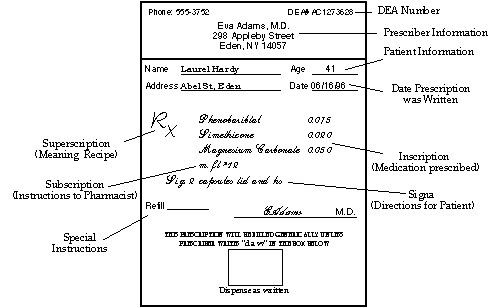
Parts of a Written PrescriptionThe word "prescription" stems from the Latin term praescriptus. Praescriptus is made up of two Latin word parts, prae-, a prefix meaning before, and scribere, a word root meaning to write. Putting it all together, prescription means "to write before," which reflects the historical fact that a prescription traditionally had to be written before a drug could be mixed and administered to a patient. Many ancient prescriptions were noted for their multiple ingredients and complexity of preparation. The importance of the prescription and the need for complete understanding and accuracy made it imperative that a universal and standard language be used. Thus, Latin was adopted, and its use was continued until approximately a generation ago. Present day prescriptions are written in English, with doses given in the metric system, but often you still find contracted Latin words and Roman numerals intertwined. The ancient "Rx" and the Latin "Signatura," abbreviated as Sig., and the occasional Roman numeral are all that remain of the ancient art of the prescription. A prescription is a written order for compounding, dispensing, and administering drugs to a specific client or patient and once it is signed by the physician it becomes a legal document! Prescriptions are required for all medications that require the supervision of a physician, that must be controlled because they are addictive and carry the potential of being abused, and that could cause health threats from side effects if taken incorrectly, for example heart medications (cardiac drugs), insulin, and antibiotics. Parts of the Medication Prescription FormThe individual sections on the prescription pad, stripped to its barest form, consist of the superscription, the inscription, the subscription, the signa, and the name of the prescriber written within the confines of a form. The date and patient information is followed by the superscription, which is followed by the inscription, then the subscription. Next follows the signatura.
2. The inscription is also called the body of the prescription, and provides the names and quantities of the chief ingredients of the prescription. Also in the inscription you find the dose and dosage form, such as tablet, suspension, capsule, syrup. 3. The subscription, which gives specific directions for the pharmacist on how to compound the medication. These directions to the pharmacist are usually expressed in contracted Latin or may consist of a short sentence such as: "make a solution," "mix and place into 10 capsules," or "dispense 10 tablets." However, that was in the old days. Today... doctors just name the pill! 4. The signatura (also called sig, or transcription), gives instructions to the patient on how, how much, when, and how long the drug is to be taken. These instructions are preceded by the symbol “S” or “Sig.” from the Latin, meaning "mark."
5. Below the signatura line is room for special instructions, such as the number of times the prescription may be refilled, if any. You will also find the purpose of the prescription, special instructions, warnings followed by the signature of the prescriber.
| ||
|

 Remember:



 Subject Navigation:

 Self-Study Navigation
© Copyright 2003-2013 Advanced Medical Assistant Web Design, LLC all rights reserved.